Note
Go to the end to download the full example code.
Does pyPTE recover the direction of a known one-way coupling?#
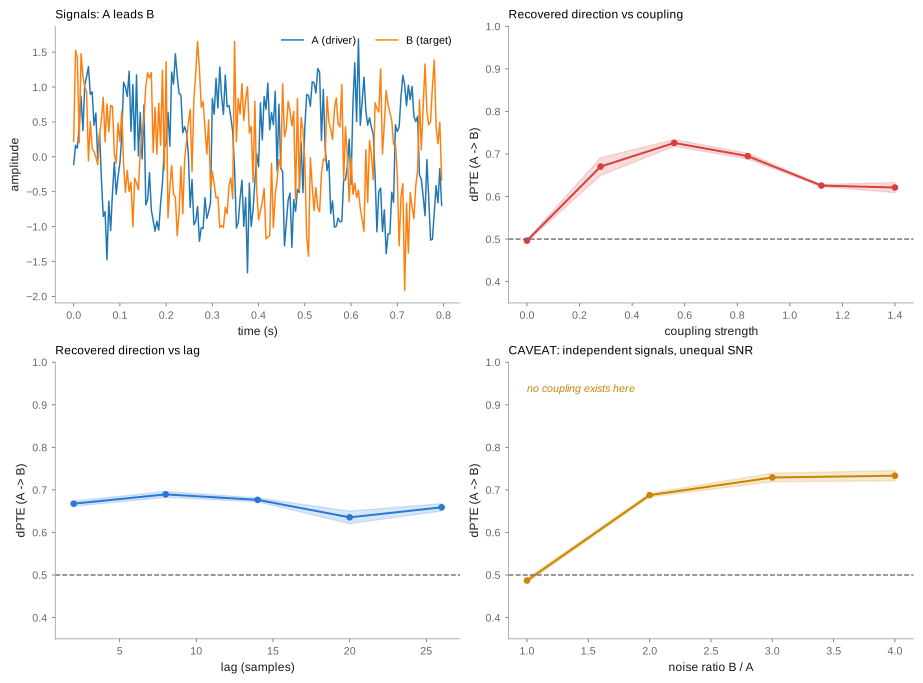
The simplest ground truth there is: one oscillator drives a second with a fixed lag and nothing flows back. Sweeps coupling strength and lag, and checks that dPTE sits at 0.5 when the two are independent.
The last panel is the catch. Two independent oscillators that differ only in signal-to-noise ratio produce a large spurious dPTE, because the noisier channel is harder to predict from its own past. Read raw dPTE on its own and an SNR gap looks just like coupling.
Run with:
uv run python -m examples.two_node_coupling [--quick]
sweeping coupling strength ...
/home/runner/work/pyPTE/pyPTE/pyPTE/core/pyPTE.py:481: RuntimeWarning: 15 phase bins: with fewer than 16, the direction dPTE reports for a real coupling can depend on the delay, even flipping sign; significance against chance is unaffected. To rely on the direction, analyse windows of at least 3641 samples, or set binning to 16 or more.
  d_phase, analysis_delay, n_bins = prepare_phase(
sweeping transmission lag ...
sweeping SNR asymmetry between independent signals ...

results
  uncoupled, equal noise   dPTE = 0.496   (expect ~0.5)
  strongest coupling       dPTE = 0.621   (expect > 0.5)
  reverse direction        dPTE = 0.332   (expect < 0.5)
  independent, 4x noise  dPTE = 0.733   (SPURIOUS)

verified: direction is recovered when it exists and absent when it does not,
          but unequal SNR alone produces a comparable dPTE, so raw values
          must be tested against surrogates before they mean anything.
import argparse

import matplotlib.pyplot as plt
import numpy as np

from examples.utils import style
from examples.utils.plotting import FIGURES, save, use_house_style
from pyPTE import PTE

FS = 250.0
NOISE = 0.3


def oscillator(rng: np.random.Generator, n: int, freq: float = 10.0) -> np.ndarray:
    """A narrowband rhythm whose phase drifts, so two of them never stay aligned.

    A pure sinusoid would be a poor stand-in for an independent rhythm: two of
    them at the same frequency hold a fixed phase offset forever, which any
    phase-based measure correctly reports as a constant lead. Diffusing the
    phase makes independent oscillators genuinely independent.
    """
    drift = np.cumsum(rng.normal(0.0, 0.4 / np.sqrt(FS), n))
    return np.sin(2 * np.pi * freq * np.arange(n) / FS + drift)


def simulate(coupling: float, lag: int, n_samples: int, seed: int) -> np.ndarray:
    """Channel 0 drives channel 1 by `lag` samples with strength `coupling`.

    Both channels carry the same amount of additive noise. That symmetry is not
    cosmetic: unequal noise on its own creates apparent direction, as the final
    panel of this example demonstrates.
    """
    rng = np.random.default_rng(seed)
    driver = oscillator(rng, n_samples) + NOISE * rng.standard_normal(n_samples)

    # the target keeps a rhythm of its own, which the coupling progressively
    # displaces, so that coupling = 0 leaves two unrelated oscillators
    intrinsic = oscillator(rng, n_samples)
    target = (
        coupling * np.roll(driver, lag)
        + max(1.0 - coupling, 0.0) * intrinsic
        + NOISE * rng.standard_normal(n_samples)
    )
    return np.vstack([driver, target])


def sweep(values, *, vary: str, n_samples: int, seeds: int) -> np.ndarray:
    """Return dPTE[driver -> target] for each value, one row per seed."""
    out = np.empty((seeds, len(values)))
    for s in range(seeds):
        for k, value in enumerate(values):
            coupling = float(value) if vary == "coupling" else 0.9
            lag = 12 if vary == "coupling" else int(value)
            dPTE, _ = PTE(simulate(coupling, lag, n_samples, seed=s))
            out[s, k] = dPTE[0, 1]
    return out


def snr_bias(ratios, *, n_samples: int, seeds: int) -> np.ndarray:
    """dPTE between two INDEPENDENT oscillators whose noise levels differ."""
    out = np.empty((seeds, len(ratios)))
    for s in range(seeds):
        for k, ratio in enumerate(ratios):
            rng = np.random.default_rng(1000 + s)
            a = oscillator(rng, n_samples) + NOISE * rng.standard_normal(n_samples)
            b = oscillator(rng, n_samples) + NOISE * ratio * rng.standard_normal(
                n_samples
            )
            dPTE, _ = PTE(np.vstack([a, b]))
            out[s, k] = dPTE[0, 1]
    return out


def _trend(ax, x, data, *, color, xlabel, title, ylim=(0.35, 1.0)):
    mean, sd = data.mean(0), data.std(0)
    ax.plot(x, mean, "o-", color=color, lw=1.5, ms=4)
    ax.fill_between(x, mean - sd, mean + sd, color=color, alpha=0.18)
    ax.axhline(0.5, ls="--", lw=1, color="0.4")
    ax.set(xlabel=xlabel, ylabel="dPTE (A -> B)", title=title, ylim=ylim)


def main(quick: bool = False) -> None:
    use_house_style()
    n_samples = 3000 if quick else 8000
    seeds = 2 if quick else 5

    couplings = np.linspace(0.0, 1.4, 6 if quick else 10)
    lags = np.arange(2, 30, 6 if quick else 3)
    ratios = np.linspace(1.0, 4.0, 4 if quick else 7)

    print("sweeping coupling strength ...")
    by_coupling = sweep(couplings, vary="coupling", n_samples=n_samples, seeds=seeds)
    print("sweeping transmission lag ...")
    by_lag = sweep(lags, vary="lag", n_samples=n_samples, seeds=seeds)
    print("sweeping SNR asymmetry between independent signals ...")
    by_ratio = snr_bias(ratios, n_samples=n_samples, seeds=seeds)

    fig, axes = plt.subplots(2, 2, figsize=(9.5, 7), constrained_layout=True)

    signal = simulate(0.9, 12, n_samples, seed=0)
    window = np.arange(200)
    axes[0, 0].plot(window / FS, signal[0, :200], lw=1.1, label="A (driver)")
    axes[0, 0].plot(window / FS, signal[1, :200], lw=1.1, label="B (target)")
    axes[0, 0].set(xlabel="time (s)", ylabel="amplitude", title="Signals: A leads B")
    axes[0, 0].legend(loc="upper right", ncols=2, fontsize=8)

    _trend(
        axes[0, 1],
        couplings,
        by_coupling,
        color=style.OBS,
        xlabel="coupling strength",
        title="Recovered direction vs coupling",
    )
    _trend(
        axes[1, 0],
        lags,
        by_lag,
        color=style.BLUE,
        xlabel="lag (samples)",
        title="Recovered direction vs lag",
    )
    _trend(
        axes[1, 1],
        ratios,
        by_ratio,
        color=style.AMBER,
        xlabel="noise ratio  B / A",
        title="CAVEAT: independent signals, unequal SNR",
    )
    axes[1, 1].text(
        ratios[0],
        0.93,
        "no coupling exists here",
        fontsize=8,
        color=style.AMBER,
        style="italic",
    )

    save(fig, FIGURES / "two_node_coupling.png")

    uncoupled = by_coupling[:, 0].mean()
    strongest = by_coupling[:, -1].mean()
    reverse, _ = PTE(simulate(0.9, 12, n_samples, seed=0))
    worst_bias = by_ratio[:, -1].mean()

    print("\nresults")
    print(f"  uncoupled, equal noise   dPTE = {uncoupled:.3f}   (expect ~0.5)")
    print(f"  strongest coupling       dPTE = {strongest:.3f}   (expect > 0.5)")
    print(f"  reverse direction        dPTE = {reverse[1, 0]:.3f}   (expect < 0.5)")
    print(
        f"  independent, {ratios[-1]:.0f}x noise  dPTE = {worst_bias:.3f}   (SPURIOUS)"
    )

    assert abs(uncoupled - 0.5) < 0.05, "uncoupled signals should show no direction"
    assert strongest > 0.6, "strong coupling should be clearly directional"
    assert reverse[1, 0] < 0.5, "the reverse direction must be suppressed"
    assert (by_lag > 0.5).all(), "direction should be recovered at every lag tested"
    assert worst_bias > 0.6, (
        "the SNR caveat should be visible; if this fails the demonstration of the "
        "limitation is no longer valid"
    )

    print(
        "\nverified: direction is recovered when it exists and absent when it does not,"
        "\n          but unequal SNR alone produces a comparable dPTE, so raw values"
        "\n          must be tested against surrogates before they mean anything."
    )


if __name__ == "__main__":
    parser = argparse.ArgumentParser(description=__doc__)
    parser.add_argument("--quick", action="store_true", help="fewer samples and seeds")
    main(**vars(parser.parse_args()))
Total running time of the script: (0 minutes 0.294 seconds)